

Ulnar Nerve Entrapment NHS Exercises: Safe Relief for Desk Workers

You know the feeling: a fizzing sensation in your ring finger, an ache radiating from your elbow, and the urge to shake out your hand every few minutes. These telltale signs often point to ulnar nerve compression, and ignoring them rarely makes things better. If you're dealing with this frustrating condition, ulnar nerve entrapment NHS exercises can help you calm symptoms and get back to focused work without fueling more irritation. We'll walk through gentle moves, smart desk habits, and where ergonomic devices fit so you can stay comfortable, aligned, and in control.
Understanding Ulnar Nerve Entrapment

The ulnar nerve threads from your neck, past the inner elbow (the cubital tunnel), into your hand. When it's compressed, most often at the elbow, you may feel numbness in the little and ring fingers, aching at the inner elbow, and weakness with grip. This is often called cubital tunnel syndrome. For desk workers, the culprits are familiar: sustained elbow bend while typing, leaning on the elbow during meetings, and a workstation that forces reach and twist. Addressing mechanics plus doing NHS-informed gliding restores smooth nerve motion—especially when paired with evidence-based routines like these cubital tunnel syndrome exercises to reduce ulnar nerve irritation.
Common Symptoms and Risk Factors
Key signs include tingling or "pins and needles" in the little and ring fingers, night symptoms when you sleep with your elbow bent, and reduced pinch strength. Risk rises with prolonged elbow flexion, direct pressure on the inner elbow, repetitive elbow bending, and tight areas along the nerve route (neck, shoulder, forearm). If you've been cradling your phone, resting elbows on hard armrests, or working with a keyboard that sits too far away, you're adding load.
When to Seek NHS Medical Advice
See your GP if symptoms persist beyond a few weeks even though self-care, if tingling worsens or spreads, or if weakness shows up (dropping objects, visible hand muscle wasting). The NHS advises evaluation for severe or progressive cases and when conservative care doesn't help within several weeks. Medical review protects nerve health and helps you decide on splints, medications, or referral. This article is general information and not a diagnosis.
NHS Exercise Principles: How to Stretch and Glide Safely

Start gentle. NHS-informed approaches emphasize nerve glides, smooth excursions that help the ulnar nerve slide, over hard end-range stretching. You're aiming for a mild, curious sensation at the little finger side, not pain. Keep the neck long, shoulders relaxed, and motions slow. Pair the exercises with better desk mechanics and brief movement snacks during the day for best results.
Warm-Up, Dosage, and Progression
Begin with easy range-of-motion for the neck, shoulder rolls, and a few wrist circles. Start with 1 set of ~10 slow reps for each glide, 1–3 times per day. Hold gentle end positions for about 15–30 seconds where noted. If symptoms settle within 24 hours, add a second set or an extra session. Progress from "sliders" to "tensioners" only when symptoms are calm for several days.
Pain Rules and Red Flags
Mild tingling is fine. Pins-and-needles that build, sharp pain at the inner elbow, or symptoms that linger after you stop are not. Back off intensity, reduce reps, or switch to a lighter version. Stop and seek medical advice if weakness appears, night pain escalates, or numbness becomes constant.
Ulnar Nerve Entrapment Exercises (NHS-Informed): Step-by-Step
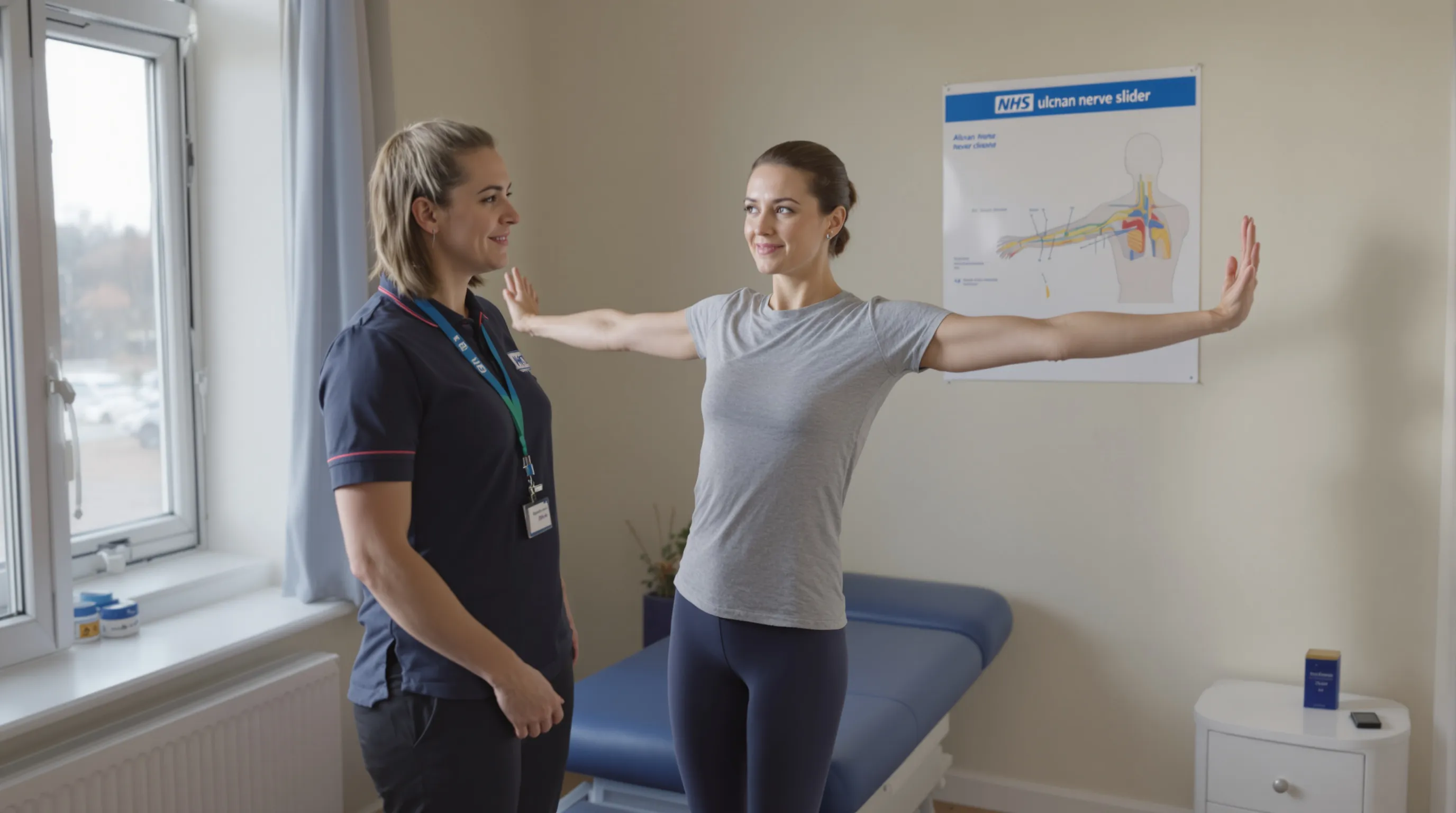
These ulnar nerve entrapment NHS exercises prioritize smooth, pain-free motion. Move slowly, breathe normally, and keep your shoulders soft.
Ulnar Nerve Slider (Gentle Floss)
• Starting position: Arm out to the side at shoulder height, palm facing the wall. Neck tall, shoulders relaxed.
• Movement: Slowly bend the elbow and bring fingertips toward the same-side ear while you tilt your head toward that hand (adds slack). Then straighten the elbow as you tilt your head away (adds tension). Flow in and out for 8–10 reps. Switch sides. The goal is silky motion, not a hard stretch.
Ulnar Nerve Tensioner (Advanced Progression)
• Starting position: Shoulder at 90°, elbow bent, wrist extended, palm up, as if holding a tray.
• Movement: Gently straighten the elbow while side-bending your head away. Return to start. Do 6–8 slow reps if your symptoms are quiet. Alternate version: with the elbow straighter, bend the elbow as you look toward the hand (slack), then extend the wrist and look away (tension). Use only when sliders feel easy and symptom-free.
Wrist Extension–Flexion Glide for the Ulnar Nerve
• Position: Arm in front of you, elbow softly bent.
• Movement: Extend the wrist (palm away) and gently assist with the other hand for a 10–15 second hold, then ease into flexion (palm toward you). Alternate 6–8 times. Keep pressure light.
Night Positioning and Towel Technique to Reduce Compression
Night is prime time for irritation because many of us sleep with elbows bent. Wrap a small towel around your elbow and secure it with a loose band to discourage deep flexion, or use a padded night splint to keep the elbow near straight. Aim for a few weeks of consistent use to gauge benefit.
Mobility That Decompresses the Pathway

Opening tight links along the neck-to-hand chain reduces strain on the ulnar nerve. Work upstream and downstream, neck, ribcage, shoulder, forearm, for smoother gliding.
Wrist Flexor and Forearm Fascial Stretch
Extend your arm with the elbow slightly bent. Pull the palm gently back with your other hand until you feel a mild stretch along the inner forearm. Hold 15–20 seconds, 2–3 times. Flip to a light wrist-flexion stretch if you're tight on the back of the forearm. No forcing.
Thoracic Extension and First Rib Mobility
Sit tall on the front edge of your chair. Place a foam roller or a rolled towel across your upper back. Lean back over it, supporting your head, and take 5–8 slow breaths. Do 2–3 spots along the upper back. Then perform 8–10 "floor angels" or wall slides to open the chest. Better thoracic mobility lowers neck tension on C8–T1 roots that feed the ulnar nerve.
Pectoral Doorway Stretch to Open the Front of the Shoulder
Stand in a doorway with the forearm on the frame at shoulder height. Gently step through until you feel a front-of-shoulder stretch. Hold 20–30 seconds, 2–3 rounds each side. Keep ribs down and shoulders low to avoid neck strain.
Strength and Work Habits for Lasting Relief

Relief sticks when your posture muscles share the load and your workflow stops provoking the nerve. Small, consistent changes beat heroic weekend sessions.
Scapular Stability and Posture Reset
Twice daily, do 2 sets of 8–10 "scapular sets": sit tall, gently draw shoulder blades down and slightly together, pause 3 seconds, release. Add light rows with a band and external rotations to build endurance. Think long neck, soft ribs, elbows near the body, neutral, not rigid.
Elbow-Friendly Grip, Typing, and Short Breaks
Avoid resting the inner elbow on hard edges or armrests. Keep phone calls on speaker or with a headset to avoid bent-elbow cradling. Use a relaxed, light grip on your mouse. Follow a 30–60 minute rhythm: stand up, shake out hands, do 10 seconds of wrist circles and a slider. These micro-breaks reduce swelling and restore glide.
Workstation Setup for Neutral Alignment and Minimal Reach
Bring the keyboard close so your elbows rest near 90° and your forearms stay level. Lower the chair so your feet are supported and shoulders aren't hiked. Keep the mouse or central pointing device close to midline, no long reach, no inward wrist bend. Place frequently used items within easy reach to avoid repeated deep elbow flexion.
When to Escalate Care: NHS Pathways and Recovery Timelines
Most mild to moderate cases improve with consistent exercise, night positioning, and activity changes over several weeks to months. Escalate care if symptoms are severe at onset, if weakness or muscle wasting is present, or if there's no improvement after several weeks of diligent self-care.
Splints and Activity Modification
Night splinting to keep the elbow straighter reduces nocturnal compression. By day, avoid deep elbow bend for long periods, reduce repetitive elbow flexion/extension, and pad contact points. These basics give the nerve time and space to calm.
Medications, Injections, and Imaging
Short courses of NSAIDs (for example, ibuprofen if appropriate for you) may ease pain and inflammation. Your GP may consider imaging or nerve studies to gauge compression. In some cases, a corticosteroid injection is discussed, though exercise and ergonomics remain first-line.
Surgical Decompression and Return-to-Work Considerations
If conservative care fails or deficits progress, surgical options include cubital tunnel release or medial epicondylectomy. Expect a brief immobilization period, graded physiotherapy, and a gradual return to full duties over weeks to months, depending on your work demands and surgical approach.
Conclusion
Less strain, more control. That's the promise when you pair ulnar nerve entrapment NHS exercises with a smarter desk and compassionate habits. Keep glides gentle, elbows near neutral, and pressure off the inner elbow. Build shoulder endurance. Sleep with your elbow straighter. If symptoms persist or strength fades, involve your GP early, nerve health is time-sensitive.
Where ergonomic devices help, beautifully and practically:
• Central pointing to stop the reach: A RollerMouse keeps your hands close to the keyboard, so there's no wide mouse reach, less elbow bend, and smoother, centered control.
• Touchpad-like precision with palm support: SliderMouse Pro lets you glide in front of your body with relaxed shoulders and a neutral wrist.
• Adjustable angles when you do need a mouse: UniMouse opens your hand, reduces grip force, and lets you tune tilt to your comfort.
• Compact typing that reduces reach: Balance Keyboard brings your elbows in and minimizes ulnar-side strain.
If you landed here looking for ulnar nerve entrapment NHS exercises, you're in the right place. Start light, stay consistent, and build from there.
Key Takeaways
- Start with ulnar nerve entrapment NHS exercises like gentle nerve sliders, then progress to tensioners only after several calm days without symptom flare-ups.
- Use night positioning—a towel wrap or elbow splint—to keep the elbow near straight and reduce nocturnal compression.
- Follow pain rules: mild tingling is fine, but sharp elbow pain, worsening pins-and-needles, or lingering symptoms mean you should reduce intensity or stop.
- Optimize your desk setup to minimize elbow bend and reach—keep the keyboard and mouse close, avoid leaning on the inner elbow, and take 30–60 minute micro-breaks with a quick slider.
- Seek NHS medical advice if symptoms persist beyond a few weeks, weakness appears, or strength declines, and consider splints, medications, or further evaluation if conservative care fails.
Frequently Asked Questions
What are the best ulnar nerve entrapment NHS exercises to start with?
Begin with gentle nerve glides, not hard stretches. The ulnar nerve “slider” is first-line: elbow bends as your head tilts toward the hand (slack), then elbow straightens as your head tilts away (tension). Add light wrist extension–flexion glides. Move slowly, keep shoulders relaxed, and avoid provoking symptoms.
How often should I do ulnar nerve entrapment NHS exercises?
Start with 1 set of about 8–10 slow reps per glide, 1–3 times daily. Hold gentle end positions for 15–30 seconds where noted. If symptoms settle within 24 hours, add a second set or an extra session. Progress to “tensioners” only after several calm days on sliders without lingering tingling or pain.
When should I see a GP for ulnar nerve entrapment, according to NHS guidance?
Seek medical advice if symptoms persist beyond a few weeks despite self-care, if tingling spreads or becomes constant, nighttime pain escalates, or if weakness appears (dropping objects, visible muscle wasting). Severe or progressive cases merit earlier evaluation to discuss splints, medications, imaging, or referral and to protect nerve health.
How can I reduce ulnar nerve compression at night and at my desk?
At night, wrap a small towel around the elbow or use a padded splint to discourage deep bending. At your desk, keep elbows near 90°, keyboard and mouse close, forearms level, and avoid resting the inner elbow on hard edges. Take brief movement breaks hourly for wrist circles and a quick slider.
How long does ulnar nerve entrapment take to heal without surgery?
Many mild to moderate cases improve in several weeks to a few months with consistent glides, night splinting, and activity changes. Timelines vary by severity and workload. If you see no improvement after several weeks, or weakness progresses, consult your GP—earlier intervention can prevent persistent deficits.
Can I keep strength training with cubital tunnel syndrome?
Yes, with modifications. Prioritize scapular stability, light rows, and external rotations. Avoid prolonged deep elbow flexion, heavy biceps curls, narrow-grip presses, or leaning on the inner elbow. Use neutral wrist positions and lighter loads that don’t increase tingling. Stop exercises that provoke symptoms and progress gradually.
